
Polar night in Tromsø runs from roughly November 27 to January 15, and it isn't the black-out most people picture. The sun stays below the horizon the whole time, but a few hours of pale blue and pink twilight still show up around midday. Those long dark hours are exactly what makes this stretch one of the better windows for the northern lights, though clouds, not darkness, are what usually decide whether you actually see them.
TL;DR:
- Cloud cover during winter nights is the main obstacle to seeing the northern lights, occurring only about 30 to 40 percent of the time along the coast.
- Most clear nights typically happen earlier in the season, from late November to early December, before deep winter low-pressure systems settle in.
- The best photo conditions occur during the blue hour around midday, with long exposures, a tripod, and cold weather gear for batteries essential.
- Flexible, multi-night trips with real-time guide adjustments improve chances of clear-sky aurora viewing compared to fixed plans or single-night bookings.
- Staying near the city center in Tromsø offers better access to twilight activities, but inland spots like Skibotn provide more consistent snow and clearer skies for winter excursions.
Table of Contents
- When Is Polar Night in Tromsø, Exactly?
- What Does the Light Actually Look Like?
- Why Weather Matters More Than Darkness
- How Good Are Your Aurora-Viewing Odds?
- What to Do During Polar Night, Day and Night
- Planning Your Trip: Length, Packing, and Logistics
- How Local Guides Actually Chase the Aurora
- Polar Night Traditions and Local Life in Tromsø
- Where to Stay During Polar Night
- Should You Actually Plan a Trip Around Polar Night?
- See the Aurora with Local Guides Who Know Where to Go
- Where to Check Conditions Before and During Your Trip
- Sources
When Is Polar Night in Tromsø, Exactly?
The dates vary a little depending on who you ask, because Tromsø's mountains complicate a simple sunrise/sunset calculation. Most travel sources, including Fjord Tours, cite November 27 through January 15 as the standard window. But that's the astronomical calculation, measuring when the sun's center drops below the geometric horizon. Central Tromsø sits surrounded by peaks, so the sun can disappear behind the terrain days before the astronomical date and reappear days after it, depending on exactly where you're standing in the city.
This is where the twilight classifications matter more than most guides admit. Civil twilight is bright enough to read outdoors without artificial light. Nautical twilight is dimmer, with the horizon still faintly visible. Astronomical twilight is barely distinguishable from full dark. During polar night, Tromsø typically gets a window of civil or nautical twilight in the late morning and early afternoon, which is why photos from the "darkest" weeks still show a soft blue or rose-colored sky rather than black.
If you're mapping out travel dates, keep these variants in mind:
- Astronomical polar night (official dates): roughly November 27 to January 15
- City-observed polar night (accounting for mountain shadow): can start a few days earlier and end a few days later in parts of central Tromsø
- Peak "usable twilight" period: typically visible daily between about 9:00 AM and 2:00 PM local time
None of this changes your itinerary dramatically, but it explains why two travelers visiting a week apart in December might describe wildly different light.
What Does the Light Actually Look Like?
The signature phenomenon locals call blåtimen, or "the blue hour," is the main visual event of the day. It typically settles in around midday, when the sun's light bends through the atmosphere from just below the horizon and washes the sky in deep blue, sometimes fading into pink or orange near the mountain edges. Visit Norway describes this as a period when the "darkness" reads more like a slow-motion sunset that never quite finishes.
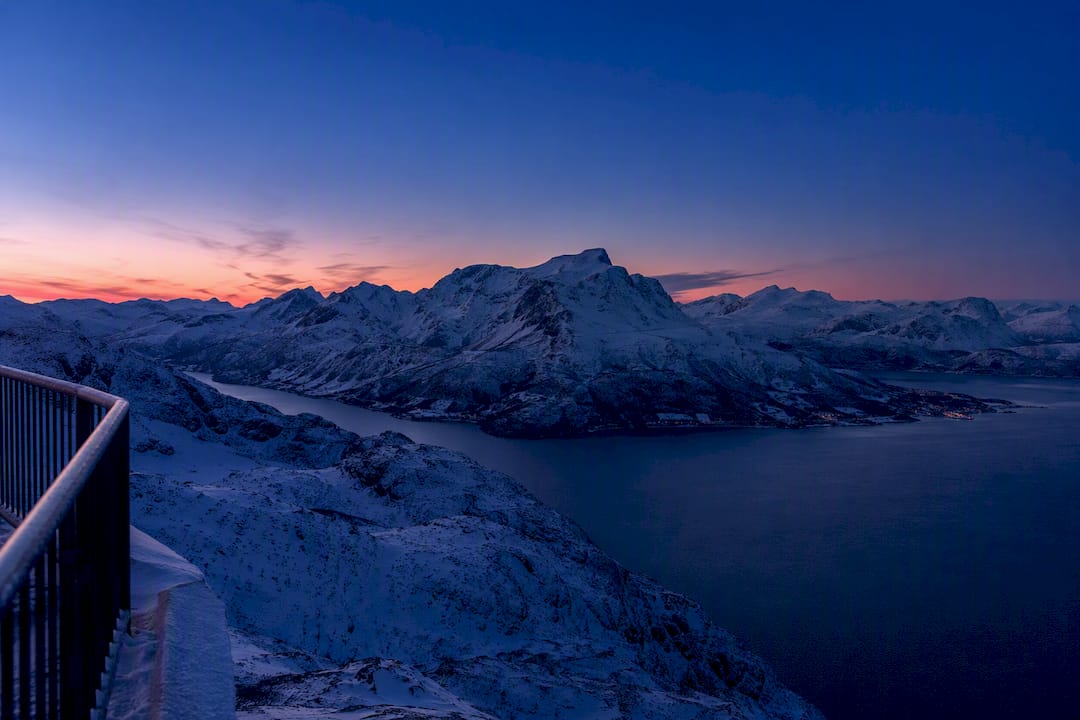
Snow amplifies everything. Fresh snow cover reflects ambient light back upward, so even a modestly lit sky can make the landscape feel brighter than the numbers suggest. The sea does something similar on calm days, holding a mirror to the color overhead. Cloud cover, ironically, can either mute the blue hour into flat gray or, when thin and high, catch the light and glow pink for a few extra minutes.
For photography, this light rewards patience over speed:
- Bring a tripod. Blue hour exposures often run several seconds even at a wide aperture.
- Shoot in manual mode and bracket your exposures. Camera meters get confused by low-contrast polar skies.
- Cold drains batteries fast. Carry at least two spares and keep them in an inside pocket, close to your body, per general guidance from The Norwegian Standard.
Pro Tip: Shoot the blue hour in RAW, not JPEG. The color gradients are subtle enough that in-camera processing tends to flatten them, and you'll want the flexibility to pull out the pink and blue separately in editing.
Why Weather Matters More Than Darkness
Tromsø's coastal position means the Gulf Stream keeps temperatures milder than the latitude suggests, but it also drags in near-constant moisture off the Norwegian Sea. That moisture becomes cloud, and cloud is the single biggest threat to your aurora plans, not the sun's schedule. Fully clear nights along the coast happen only about 30 to 40 percent of the time, which is the real number to plan around.
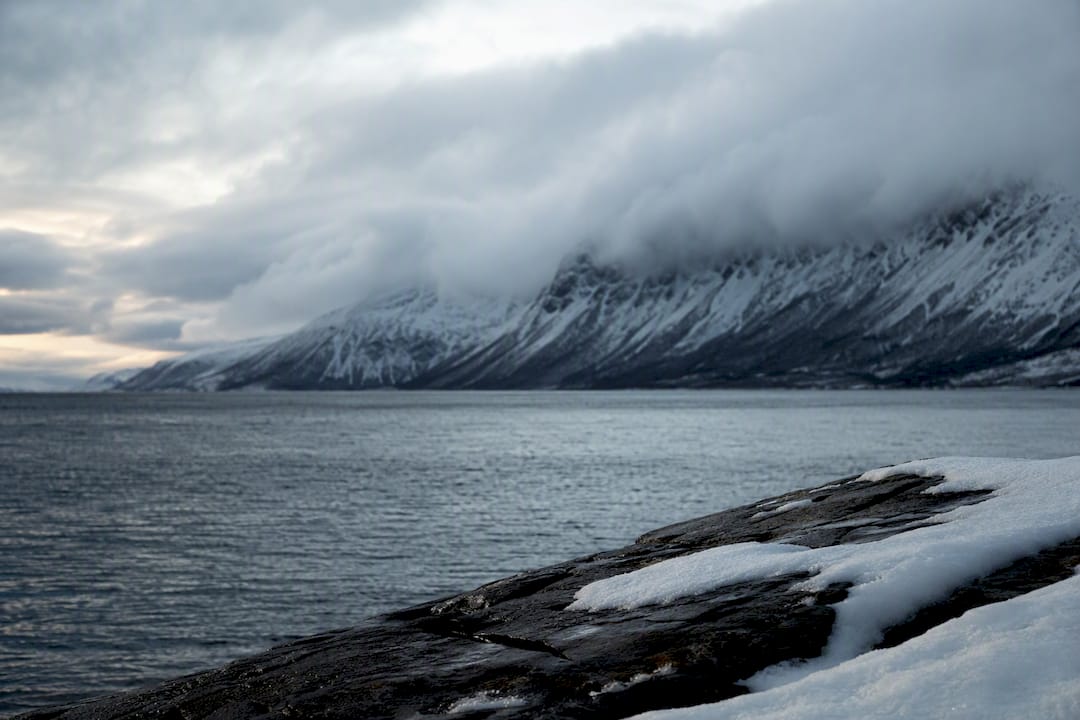
There's a seasonal wrinkle worth knowing. Late November into early December often shows better cloud statistics than January or February, before the deepest winter low-pressure systems settle in off the Atlantic. That doesn't make early winter a guaranteed bet, but it's a reasonable argument for booking earlier in the polar night window rather than later, if your dates are flexible.
When coastal skies won't cooperate, or when you need reliable snow for dogsledding or snowshoeing, inland valleys are the practical fallback:
- Skibotn, about two hours from Tromsø by road, tends to hold more consistent snow and drier, clearer air than the coast.
- Lyngen and parts of Kvaløya offer similar relief from coastal cloud without the full drive to Skibotn.
- Operators running snow-dependent trips often stage from these inland spots specifically because coastal snow can thin out or turn slushy mid-winter.
How Good Are Your Aurora-Viewing Odds?
The northern lights season in Tromsø runs from October through March, but polar night gives you the longest run of usable dark hours, which is the main structural advantage this stretch has over the shoulder months. At 69.6°N, Tromsø sits inside the auroral oval, the ring around the magnetic pole where aurora activity concentrates most nights regardless of the broader geomagnetic forecast.
That geography changes how you should read a KP index number. KP measures overall geomagnetic disturbance on a scale of 0 to 9, and most aurora apps push it as the headline metric. In Tromsø, KP 1 is often enough to produce a visible aurora from a genuinely dark site, because you're already sitting under the oval. KP 3 to 4 typically brings structured, moving arcs that are unmistakable even to first-time viewers, and KP 5 or higher can fill large portions of the sky. The practical takeaway: don't skip a night just because the KP forecast looks modest. Check the cloud map first.
Clear skies happen roughly 30 to 40 percent of nights along the Tromsø coast during winter, according to PolarForecast, which is the statistic that should actually drive your trip planning, more than any KP number.
That statistic is the entire argument for staying longer. A single overnight visit is a coin flip stacked against you. Visitor guidance consistently recommends four to seven nights to give yourself multiple chances at a clear window, and building in flexibility, rather than fixed nightly plans, lets you or your guide reposition toward whichever direction the clouds are thinnest.
Timing within the night matters too. Magnetic midnight in Tromsø, the point when the sun is at its lowest relative to the magnetic pole, falls around 11:00 PM to 12:30 AM local time and is statistically the most active window, though strong substorms can flare earlier or later without warning.
What to Do During Polar Night, Day and Night
Daylight hours are short, but they're not wasted. Structure your days around the twilight window and save darkness for aurora watching.
- Ride the Fjellheisen cable car during the midday blue hour for a panoramic view over the city and surrounding fjords while the sky is at its most colorful.
- Take a fjord cruise timed to twilight, when the low light on the water and snow-covered peaks produces some of the most photogenic conditions of the trip.
- Visit indoor cultural sites, like the Arctic Cathedral or Polaria, during the darkest midday hours when outdoor light is minimal anyway.
- Book a private aurora tour for the evening, ideally with a guide who monitors cloud cover in real time and can relocate to a clearer pocket of sky.
- Try dogsledding, which often runs on wheeled carts or in staged inland valleys when coastal snow is thin, with headlamps standard for early evening departures.
When booking night activities, ask your guide directly about flexible scheduling and backup meeting points. A guide willing to shift departure time or driving direction based on the evening's cloud map is worth more than one locked into a fixed route.
Planning Your Trip: Length, Packing, and Logistics
Give yourself a buffer. A four to seven night stay, as noted earlier, is the realistic minimum for outlasting a run of cloudy weather, and building one or two flexible days into your itinerary pays off more than any other planning decision. Late December also brings holiday closures across Tromsø, including reduced public transport schedules around Christmas and New Year's, so check local operators before assuming a bus or ferry will run on its usual timetable.
Pack in layers, and don't skimp on the base layer:
- A thermal wool base layer against your skin
- A fleece or wool mid layer for insulation
- A waterproof, windproof outer shell
- Hand and foot warmers for standing outside during aurora watches
- Spare camera batteries, kept warm in an inner pocket
- A compact tripod for long-exposure shots
- A headlamp for walking on unlit trails or snowy ground
- A thermos for hot coffee or cocoa during long outdoor waits
Pro Tip: Rent a set of ice cleats for your boots if you're staying in central Tromsø. Sidewalks compact into glassy ice by December, and it's the single most common reason visitors cut outdoor plans short. For a broader rundown of seasonal logistics, Crystal Sky Venture's guide to making the most of the season covers additional local specifics worth reading before you land.
How Local Guides Actually Chase the Aurora
Guides who run aurora tours night after night develop a working rhythm that's different from checking an app once and heading out. They watch live KP charts alongside cloud radar simultaneously, because a strong geomagnetic forecast under solid cloud cover is worthless, and a modest KP under clear skies can outperform it easily. Tromsø's island and fjord geography also creates natural dark corridors to the north and east where urban light pollution drops off fast, meaning a short drive can put you under genuinely dark sky without a multi-hour trip.
If you're booking a guided tour, a few questions separate a good operator from a rigid one:
- Will you reposition mid-tour if the original site clouds over?
- What's the contingency plan if Tromsø's coast is fully overcast, such as driving toward Lyngen or Skibotn?
- Is pickup flexible enough to accommodate late changes based on the evening forecast?
Crystal Sky Venture's private Northern Lights tours build this flexibility into the structure itself, with local guides making real-time calls rather than following a fixed route regardless of conditions.
Polar Night Traditions and Local Life in Tromsø
Tromsø doesn't treat polar night as something to endure. The city leans into it. Tromsø International Film Festival, held in mid-January as the sun starts creeping back, was actually founded partly as a communal response to the darkest stretch of the year, giving residents a reason to gather indoors and celebrate right as the light begins its slow return.
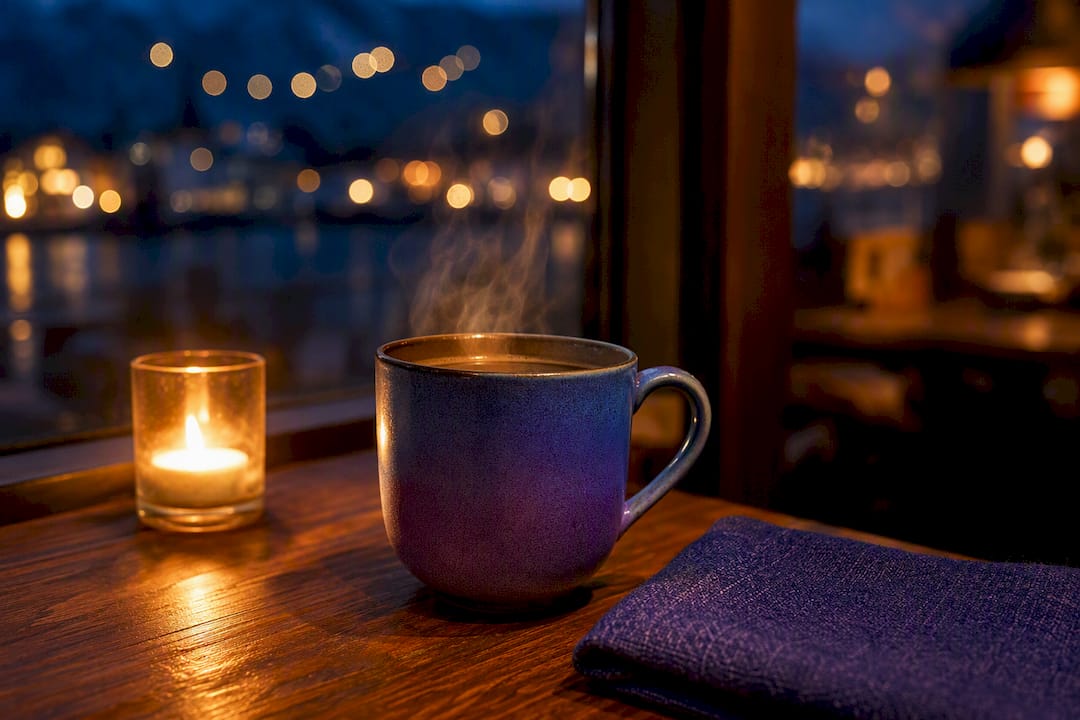
Cafés and bars extend their candlelit hours through December, and the concept of koselig, roughly translated as a deliberate coziness, shows up everywhere from window displays to how locals structure their evenings around warm drinks and low lighting rather than fighting the dark. Christmas markets in the city center run through December, lit almost entirely by string lights and candles rather than the daylight it lacks.
There's also a quieter cultural rhythm tied to the Sami communities in the wider region, where the long dark season historically shaped seasonal reindeer herding schedules and storytelling traditions passed down through winter gatherings. Visitors won't stumble into formal Sami cultural events by accident inside Tromsø proper, but several tour operators run trips into surrounding areas where this heritage is a central part of the experience.
None of this requires special planning on your part. It's simply worth knowing that the "darkness" locals live through isn't treated as a deprivation. It's a season with its own social calendar, built around light in small, deliberate doses.
Where to Stay During Polar Night
Booking early matters more here than in most European winter destinations, because Tromsø's hotel inventory is genuinely limited for a city its size, and December through mid-January overlaps with both holiday travel and peak aurora tourism.
Central Tromsø hotels put you within walking distance of restaurants, the cable car, and the harbor, which matters when daylight hours are short and you don't want to burn your only usable twilight window on a taxi ride. Properties near Storgata, the main pedestrian street, tend to book out fastest for late December and early January. If you're aiming for those exact dates, lock in a room by early fall.
Outside the city center, a handful of properties lean into the darkness itself, offering glass-roofed cabins or rooms specifically positioned for aurora viewing without leaving your bed. These book even further in advance, often six months or more ahead of peak season, precisely because the appeal is so specific.
If you're staying multiple nights and want flexibility to chase clear skies inland, a base in central Tromsø still makes more sense than an inland property, since most guided tours and transport options depart from the city regardless of where the aurora ends up being visible that night. For general accommodation-planning approaches that apply broadly to winter destination trips, resources like this guide to choosing the right area to stay in outline the kind of location trade-offs worth considering, even though it's written for a different destination.
Should You Actually Plan a Trip Around Polar Night?
Polar night rewards a specific kind of traveler. The slow blue light at midday, the total quiet of a snow-covered fjord, the payoff of a sky suddenly moving green overhead after an hour of waiting in the cold. It's a genuinely different sensory experience, and photographers, couples looking for something quieter than a typical winter getaway, and aurora-focused travelers tend to get the most out of it.
If you need reliable daylight for hiking or want guaranteed sunshine, look toward March or the midnight sun months instead. Polar night demands flexibility. The weather won't always cooperate, and travelers who build in buffer days and realistic expectations get far more out of the trip than those chasing a single perfect night.
**
See the Aurora with Local Guides Who Know Where to Go
Crystal Sky Venture runs its private Northern Lights tours with an Aurora guarantee, meaning your guide keeps adjusting the plan, not just the pitch, until conditions actually deliver. That matters most for travelers with a short window in Tromsø, photographers who need a guide willing to hold position for a specific shot, and small groups who don't want to share a bus with forty strangers on the coldest night of their trip.
For daytime hours, the private Arctic fjord expedition fills the twilight window with local storytelling and access to spots most day-trippers never see. If you're weighing options, the full tour lineup breaks down formats by group size and focus, whether that's photography, fjord exploration, or a fully custom itinerary. Check available dates for your travel window and book while December and January slots remain open.
Where to Check Conditions Before and During Your Trip
- PolarForecast's live aurora guide for real-time KP and cloud cover forecasts specific to Tromsø.
- Local road and weather services for winter driving and snow conditions before heading inland toward Skibotn or Lyngen.
Sources
- Northern Lights in Tromsø | Live aurora forecast & viewing guide | PolarForecast
- Polar night season in Tromsø | Fjord Tours
- Visiting Tromsø during polar night — what to expect | The Norwegian Standard