
Norway's northern lights season runs from late September through early April, with the shoulder months of September/October and March offering the best balance of darkness and clear skies, while November through February deliver the most hours of night. 2026 carries elevated solar activity from Solar Cycle 25's peak window, which raises your odds, but no month or year guarantees a sighting. Plan for at least three nights, ideally more.
TL;DR:
- Visiting Norway between late September and early April maximizes your chances, especially during shoulder months like September/October and March for clearer skies.
- Alta offers better odds for clear skies during winter, while Tromsø provides convenience and infrastructure, and Lofoten and Senja are better for dramatic scenery during shoulder months.
- The ideal viewing hours are from 21:00 to 02:00, with the highest activity typically between 23:00 and 00:30, and cloud cover often outweighs solar activity in importance.
- The solar peak expected in 2026 increases the likelihood of intense auroras but does not guarantee clear nights; flexible scheduling can improve chances.
- Light pollution significantly dims auroras, so choosing dark, sheltered inland spots is crucial for optimal viewing and photography.
Table of Contents
- When Is the Best Time to See Northern Lights in Norway?
- Where Are the Best Places in Norway to See the Northern Lights?
- What Time of Night Should You Watch for Auroras?
- Why Does Solar Cycle 25 Make 2026 a Strong Year?
- Does Light Pollution Ruin Northern Lights Viewing?
- What Actually Causes the Northern Lights?
- Why We Build Every Aurora Tour Around Flexibility
- Ready to Plan Your Northern Lights Trip?
- Sources
When Is the Best Time to See Northern Lights in Norway?
Every month between late September and early April counts as prime northern lights season in Norway, but the calendar isn't uniform. Some stretches trade darkness for clearer weather. Others trade comfort for sheer hours of opportunity.
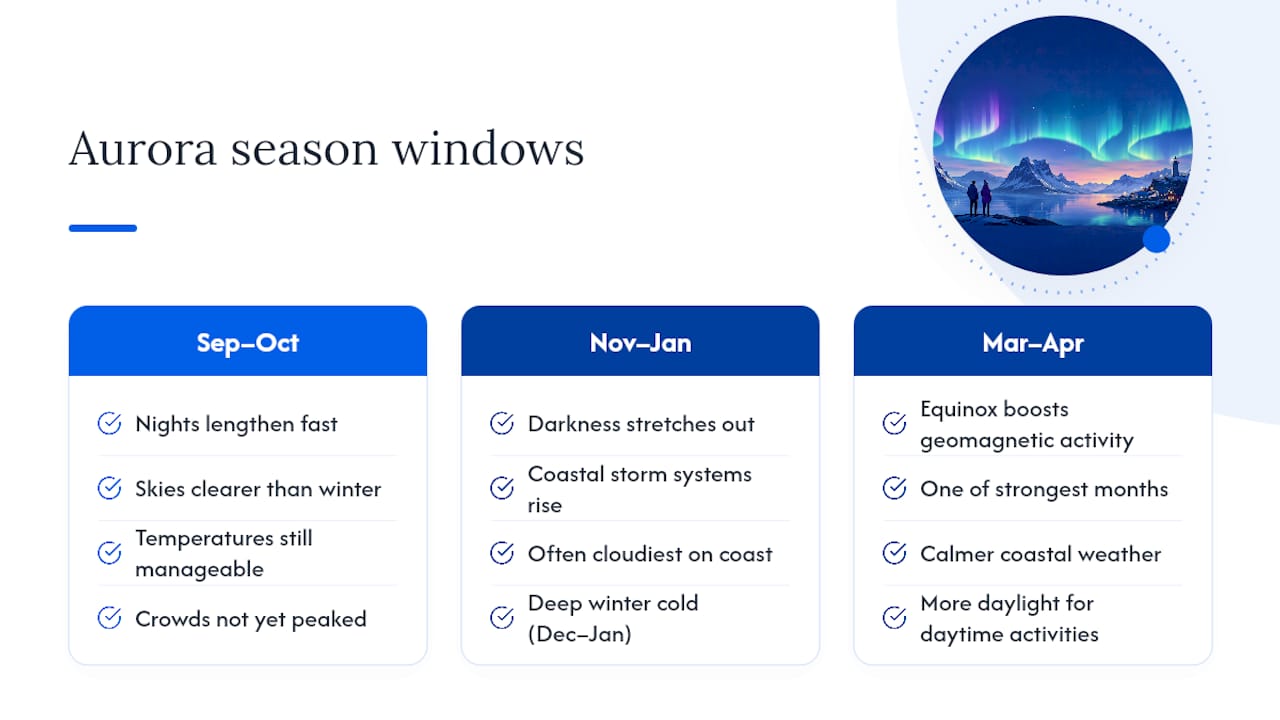
Late September to October. The season opens as nights lengthen fast. Skies tend to be clearer than in deep winter, temperatures are still manageable, and crowds haven't peaked. This is often the sweet spot for first-timers who want decent odds without brutal cold.
November. Darkness stretches out considerably, but coastal Norway starts seeing more storm systems roll in off the Norwegian Sea, which means more cloud cover exactly where a lot of tours operate.
December and January. This is the deepest darkness of the year, with some far-northern spots barely seeing the sun at all. It's also often the cloudiest stretch along the coast, so while you get more night to work with, you may spend more of it staring at overcast skies.
February. A strong compromise month. Nights are still long, but weather patterns tend to stabilize compared to the December/January storm cycle.
March to early April. The equinox effect kicks in here, a well-documented pattern where geomagnetic activity tends to pick up around the spring and fall equinoxes. Combine that with more daylight for daytime activities and often calmer coastal weather, and March becomes one of the strongest months of the whole season.
Pro Tip: If you can only travel once, pick September/October or March over deep winter. You trade a little darkness for meaningfully better odds of clear skies, and you won't be standing outside at minus 20.
Moon phase matters too, though less than most people assume. A full moon washes out fainter aurora but rarely kills a strong display. Photographers chasing the best contrast between aurora and starfield should watch new-moon windows, especially in the darker core months.
One number worth internalizing: Solar Cycle 25's predicted peak sunspot maximum sits near 115, a figure that matters more to photographers chasing strong, colorful displays than to casual viewers, since even a modest aurora reads well to the naked eye.
Where Are the Best Places in Norway to See the Northern Lights?
The general rule holds up everywhere: get above the Arctic Circle, and your odds jump. But the five names that keep coming up in every serious planning guide each offer something different.
Tromsø is the default choice for good reason. It has an airport with direct international routes, dozens of tour operators, and enough infrastructure that you're never far from a warm café between aurora chases. It's the easiest place to combine daytime activities with nighttime viewing.
Alta sits inland, away from the coastal weather systems that dump cloud cover on Tromsø and the islands. That inland position gives it a real edge in clear-sky frequency during several months of the season, and it's home to one of the world's oldest aurora observation histories.
Lofoten and Senja deliver the most dramatic scenery in northern Norway. Jagged peaks rising straight out of the sea make for the kind of aurora photograph that gets shared everywhere. The tradeoff is coastal cloud exposure, which makes these islands stronger picks during the clearer shoulder months than in the stormier heart of winter.
Svalbard is the extreme option. This far north, you get polar-night conditions where the sun doesn't rise at all for weeks, opening up round-the-clock viewing potential. It comes with specialized logistics, higher costs, and a level of remoteness that isn't for every traveler.
- Best for ease and variety: Tromsø
- Best for clear-sky odds: Alta
- Best for dramatic photography: Lofoten and Senja (shoulder months)
- Best for polar-night extremes: Svalbard
Pro Tip: If cloud cover is your biggest worry, favor inland basins over exposed coastline. Coastal microclimates in northern Norway show a repeated pattern of higher cloud frequency in mid-winter, while sheltered inland valleys often post clearer nights in the very same week.
What Time of Night Should You Watch for Auroras?
Your best window runs roughly from 21:00 to 02:00, with many of the strongest displays clustering between 23:00 and 00:30. Outside that stretch, activity doesn't stop, but you're less likely to catch a strong show without staying up until dawn.
The KP index measures geomagnetic disturbance on a scale of 0 to 9. In northern Norway, above the Arctic Circle, even a KP of 2 or 3 often produces a visible display overhead. Farther south, near Trondheim or Oslo, you typically need a KP of 5 or higher for anything visible. Forecasts update a few times daily, so check them the same afternoon you plan to head out rather than days in advance.
Cloud cover, not solar activity, usually decides your night. Checking a regional cloud forecast in the late afternoon and staying willing to drive to a clearer patch of sky matters more than any KP number.
- Three-night trip: Enough for a quick visit, but treat every clear window as a must-use night.
- Five-night trip: Widely recommended as the sweet spot for balancing schedule against odds.
- Contingency planning: Build in one buffer night if your schedule allows, especially during cloudier winter months.
Why Does Solar Cycle 25 Make 2026 a Strong Year?
NOAA's Space Weather Prediction Center tracks the sun's roughly 11-year activity cycle, and Solar Cycle 25's forecast points to a peak sunspot number near 115, with the uncertainty band stretching from late 2024 into early 2026. That range means 2026 could still be sitting inside or just past the most active stretch of the cycle.
The prediction panel's own uncertainty bands mean the "peak" isn't a single date on a calendar. It's a window, and current modeling places part of that window squarely inside 2026, which is exactly why space-weather forecasters treat this as an operational planning range rather than a fixed event.
Higher solar activity means more frequent and more intense geomagnetic storms, which translates to stronger, more visible aurora on more nights. It doesn't mean clear skies. A quiet solar year with three clear nights beats an active solar year with three cloudy ones every time.
Treat 2026 as a genuinely favorable year to book a trip, not as a guarantee that removes the need for flexible scheduling.
Does Light Pollution Ruin Northern Lights Viewing?
Light pollution cuts your visible range dramatically, even for a bright aurora. Streetlights, hotel signage, and car headlights all wash out the fainter greens and purples that make up most displays, leaving you with a duller, less colorful show than what's actually happening overhead.
The fix is straightforward: get away from town centers. Even 15 to 20 minutes outside a city like Tromsø puts you under noticeably darker skies. Look for spots with an unobstructed view toward the north, since that's where most auroral activity concentrates in Norwegian latitudes, though a strong display can fill the entire sky.
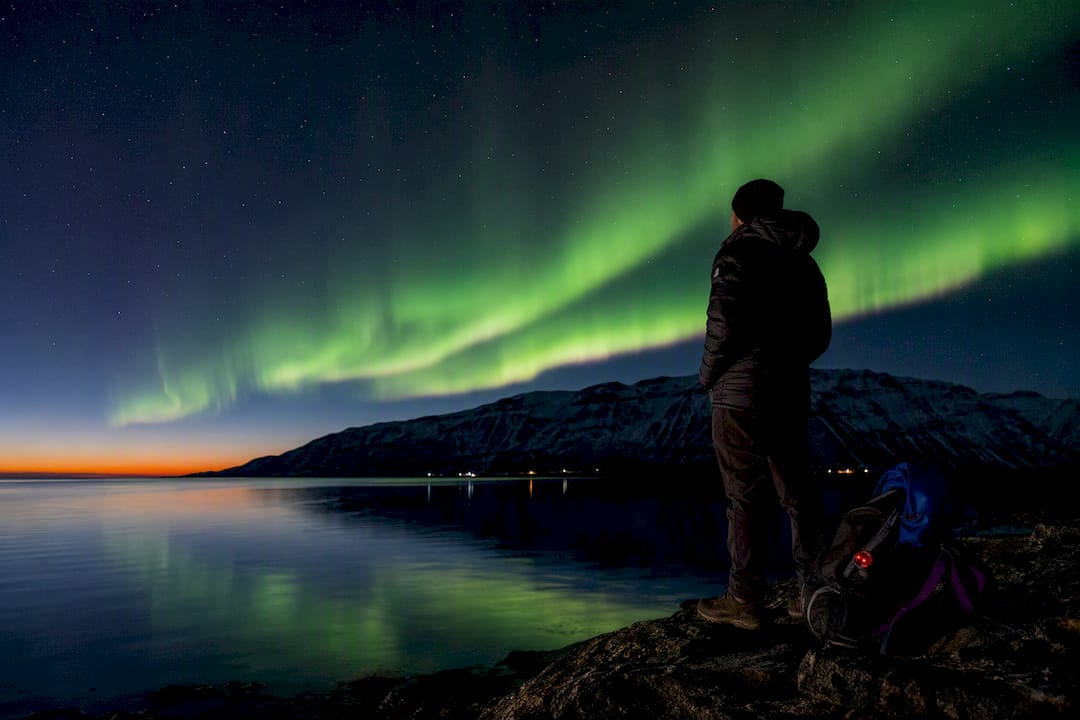
A few habits help beyond just location. Give your eyes 10 to 15 minutes to adjust to the dark before judging whether a display is happening. Use a red-light headlamp setting instead of white light if you need to check gear, since white light resets your night vision. And skip your phone screen at full brightness. A quick glance can undo minutes of adaptation.
Photographers have an added incentive to go dark: light pollution doesn't just dim what you see, it fogs long-exposure shots with orange glow along the horizon, flattening the color contrast that makes aurora photography striking in the first place.
What Actually Causes the Northern Lights?
The aurora borealis happens when charged particles from the sun, carried on the solar wind, collide with gases in Earth's upper atmosphere. Earth's magnetic field funnels those particles toward the poles, which is why the display concentrates in a ring around the northern and southern magnetic poles rather than showing up everywhere.
The colors depend on which gas gets hit and at what altitude. Oxygen produces the familiar green you see in most photos, typically around 100 to 300 kilometers up. Higher-altitude oxygen collisions can produce a rarer red. Nitrogen tends to add blue and purple tints, usually at lower altitudes.
Solar activity, sunspots, solar flares, and coronal mass ejections, controls how many charged particles reach Earth and how energetically they collide with the atmosphere. That's the direct link between the sun's roughly 11-year cycle and how often and how strongly the northern lights show up in any given year. More solar particles hitting the atmosphere means more frequent and more intense displays, though the underlying physics happens whether or not clouds let you see any of it from the ground.
Why We Build Every Aurora Tour Around Flexibility
Most of what determines a good aurora night comes down to being in the right spot when the sky clears, not just picking the right month. That's the whole logic behind running private, small-group tours instead of fixed-departure buses: our local guides can relocate the moment a cloud bank shifts, chasing a clear pocket instead of hoping one shows up where the itinerary says it should.
We back that flexibility with an Aurora Guarantee, because a rigid schedule is the enemy of good aurora odds. Local knowledge of which valley tends to clear first, or which fjord basin holds a pocket of clear sky longer than the coast, isn't something a guidebook can replace.
— Crystal Sky Venture
Ready to Plan Your Northern Lights Trip?
Reading about the season window and the KP index only gets you so far. Acting on it in real time, relocating fast when a cloud bank rolls in, choosing the right valley over the exposed coastline, is what actually separates a trip that sees the aurora from one that doesn't. That's the entire premise behind our private Northern Lights tours with an Aurora Guarantee: small groups, local guides who know which microclimate to chase that night, and a schedule built around the sky rather than a fixed departure time.

Many travelers pair an aurora night with a private Arctic fjord expedition during daylight hours, turning a single trip into a fuller picture of the region. If you want to see the full range of private departures and pick dates around your own schedule, browse our current tour options and check availability for the nights you're planning to be in Tromsø.
Sources
- Solar Cycle Progression | NOAA / NWS Space Weather Prediction Center
- Northern lights in Norway | Best places to see the aurora ... (Visit Norway / Norway Tourism)
- Northern Lights Season: When It Starts, Peaks & Ends - View Norway
- Best Time to See the Northern Lights in Norway: 2026–2027 Guide