
Tromsø's midnight sun is 24-hour daylight caused by the Earth's tilt, visible roughly from mid-May to late July, peaking near the June solstice. For photographers and travelers who want more than a snapshot from a tour bus window, the smartest way to experience it is a private guided fjord cruise or vantage-point photography sortie, timed to catch the low, warm light that never quite fades.
TL;DR:
- Private fjord cruises are ideal for capturing reflections and require minimal walking, making them suitable for couples and travelers seeking comfort.
- The best viewing window is between 11 p.m. and 1 a.m. during the mid-May to late July period, with the strongest light near the June solstice.
- Guides with local microclimate knowledge can adjust routes quickly to optimize light conditions and avoid unfavorable weather like clouds or choppy water.
- Photographers should use narrow apertures, graduated filters, and a tripod, and pack warm, windproof clothing with extra batteries and gear protection.
- Small private tours offer flexibility to chase shifting light and wildlife activity, providing a better experience than fixed-schedule group trips in unpredictable Arctic conditions.
Table of Contents
- Best Ways to Experience the Midnight Sun in Tromsø
- When and Where to See the Midnight Sun Near Tromsø
- How to Choose a Private Midnight Sun Experience
- Photography Settings and Packing Tips for the Midnight Sun
- Weather, Safety, and Logistics for Your Visit
- Cultural Events and Activities During Tromsø's Midnight Sun Season
- Wildlife and Nature Experiences Unique to This Season
- Health and Safety: Sleep, Sun Exposure, and Adjusting to Constant Daylight
- Why Private, Small-Group Tours Work Better for This Season
- Book a Private Midnight Sun Tour With Crystal Sky Venture
- Sources
Best Ways to Experience the Midnight Sun in Tromsø
Three formats dominate how visitors actually see the midnight sun around Tromsø, and each suits a different kind of traveler. None of them require you to choose between comfort and a great photograph, but they trade off convenience, exclusivity, and how much control you get over timing.
A private fjord or boat cruise puts you on the water where the midnight sun reflects off calm channels, doubling every color in the sky. These trips work well for couples and travelers who want minimal walking, since you get onboard comfort, mobility between viewpoints, and no scrambling over rock. A guided vantage-point tour, often combining the Fjellheisen cable car with a short hike or 4x4 transfer, gets you onto a mountain ridge where the sun's low arc creates dramatic, elongated shadows across the fjords below. Bespoke photography sorties go further still: your guide schedules long stationary stops at tripod-friendly landings, times the route around shifting cloud cover, and can include coaching from someone who shoots this landscape regularly.
Here's how the three formats generally break down by traveler type:
- Fjord cruises suit romantic getaways and travelers who want reflections and mobility without hiking.
- Vantage-point tours suit photographers chasing dramatic mountain light and layered compositions.
- Bespoke photography sorties suit serious photographers who want dedicated time and technical support built into the itinerary.
When and Where to See the Midnight Sun Near Tromsø
Tromsø's midnight sun window runs roughly from mid-May to late July, with the longest, most consistent daylight clustering around the June solstice. Because Tromsø sits well inside the Arctic Circle, the sun never fully sets during this stretch. Earth's axial tilt is what makes this possible, and the farther north you go, the longer that continuous daylight lasts.
Here's a practical sequence for planning your visit around the best light:
- Book your window early. Late June gives you the most reliable continuous daylight, though late May and July still offer strong golden-hour conditions.
- Pick your vantage point deliberately. Storsteinen, reached by cable car, gives you an elevated view over the city and fjords. Coastal fjords and nearby islands offer different angles that stretch shadows further and change how the light hits the water.
- Target the 11 p.m. to 1 a.m. window. This is when the sun sits lowest without dipping below the horizon, producing the warmest color and the longest shadows.
- Build in flexibility. A multi-hour sortie lets you track how conditions shift, rather than betting everything on one fixed hour.
Tromsø doesn't give you overhead midday sun. It gives you extended golden-hour light that stretches across most of the night, which is precisely why photographers plan around it rather than around a single "best moment."
How to Choose a Private Midnight Sun Experience
Not every private tour delivers the same value, and the difference usually comes down to how much local knowledge and flexibility is actually built into the itinerary. Before you book, run through a short checklist.
- Guide expertise and flexibility. A guide who knows the local microclimate can shift the route on short notice to chase a break in the clouds or better light, something a fixed-schedule group tour simply can't do.
- Photography support. Ask whether the itinerary includes dedicated stationary time, tripod-friendly landing spots, and access to a photographer who can advise on composition in real time.
- Private versus small-group format. Privacy changes the pace entirely. You're not waiting on eight other people to finish a shot before the group moves on.
- Comfort and logistics. Check the quality of the boat or vehicle, whether hotel or port pickup is included, and how gear is handled during transfers.
- Sustainability and community ties. Guides who are genuinely local and who operate with low-impact practices tend to know the land and water better, and they're investing in keeping these places worth visiting.
- Contingency policy. Weather in the Arctic shifts fast. Ask what happens if conditions turn: is there a rescheduling window, an alternate vantage point, or a refund policy?
Pro Tip: Ask your guide directly how they decide departure times. The best local operators read tide, wind, and cloud patterns hours ahead, not just a general forecast, because those small shifts determine whether you get a mirror-flat fjord or choppy water that ruins a long exposure.
Photography Settings and Packing Tips for the Midnight Sun
Shooting the midnight sun rewards patience more than gear complexity, but a few technical habits separate a good frame from a forgettable one.
For camera settings, start with a narrow aperture (f/8 to f/11) to keep both foreground and distant mountains sharp, and use a graduated neutral density filter to balance a bright sky against a darker fjord. Bracket your exposures in low light conditions where dynamic range is wide. Because the sun sits low but never fully sets, you get hours of workable golden-hour tone rather than a fifteen-minute window, so there's no need to rush your settings.
Composition benefits from working the reflections: still fjord water doubles the sky's color, and long shadows from mountains create natural layering that flat midday light never gives you. Silhouettes against the glowing horizon and framing through rock formations both play well with this kind of light.
Pack for cold, not for summer. Even bright midnight sun doesn't warm coastal air much, and temperatures can feel cold during long stationary shoots, so thermal base layers and a windproof outer shell matter more than most first-time visitors expect.
- Sturdy tripod with a low center of gravity for wind resistance
- Remote shutter trigger to eliminate camera shake during long exposures
- Extra batteries kept warm in an inner pocket, since cold drains them fast even in daylight
- Waterproof bag or cover for boat-based shooting near spray
On a boat, stabilize your tripod against a fixed point rather than the deck itself, and keep a lens cloth ready. Salt spray on a lens ruins a shot faster than almost anything else.
Weather, Safety, and Logistics for Your Visit
Sunny skies in Tromsø don't mean warm air. Coastal wind chill catches most first-time visitors off guard, so dress in layers with a windproof outer shell regardless of how bright it looks outside.
Boat and land tours come with different logistics. Boat trips involve fixed boarding times, some motion, and limits on how much gear you can bring aboard. Land-based vantage tours involve short walks or vehicle transfers and tend to be easier for anyone with mobility concerns.
Before you head out, confirm a few basics with your operator:
- Check the forecast the morning of your tour, not the week before.
- Tell your guide about any mobility needs or medical concerns in advance.
- Confirm your exact pickup point and get an emergency contact number.
- Ask what the rescheduling or refund policy looks like if weather shuts down the original plan.
Cultural Events and Activities During Tromsø's Midnight Sun Season
Continuous daylight changes how the city itself behaves. Restaurants keep terraces open well past midnight, locals go for late hikes and swims as if it's afternoon, and the town's normal rhythm of day and night mostly dissolves for a couple of months.
Summer in Tromsø brings a run of outdoor concerts, art markets, and food festivals that lean on the extended daylight rather than fighting it. Museums and galleries in the city center often extend their hours, since visitors are out and about at times that would be unthinkable back home. The Arctic Cathedral and harbor area both take on a different character under a sky that never quite goes dark.
Fishing culture stays visible too. Boats still head out at odd hours, and seafood markets run on schedules built around the season rather than the clock. Many travelers pair a private midnight sun photography sortie with a stop at a local market or a late dinner at a harborside restaurant, since the light makes even a simple walk through town feel worth photographing.
The layered effect of these events happening under permanent daylight is part of what makes visiting Tromsø in summer feel different from anywhere further south. Locals treat midnight as just another hour, and after a day or two, most visitors start to as well.
Wildlife and Nature Experiences Unique to This Season
Midnight sun season opens up wildlife viewing windows that simply don't exist during Tromsø's dark winter months. Whales, seabirds, and coastal marine life become far easier to spot and photograph when there's no rush against fading light.
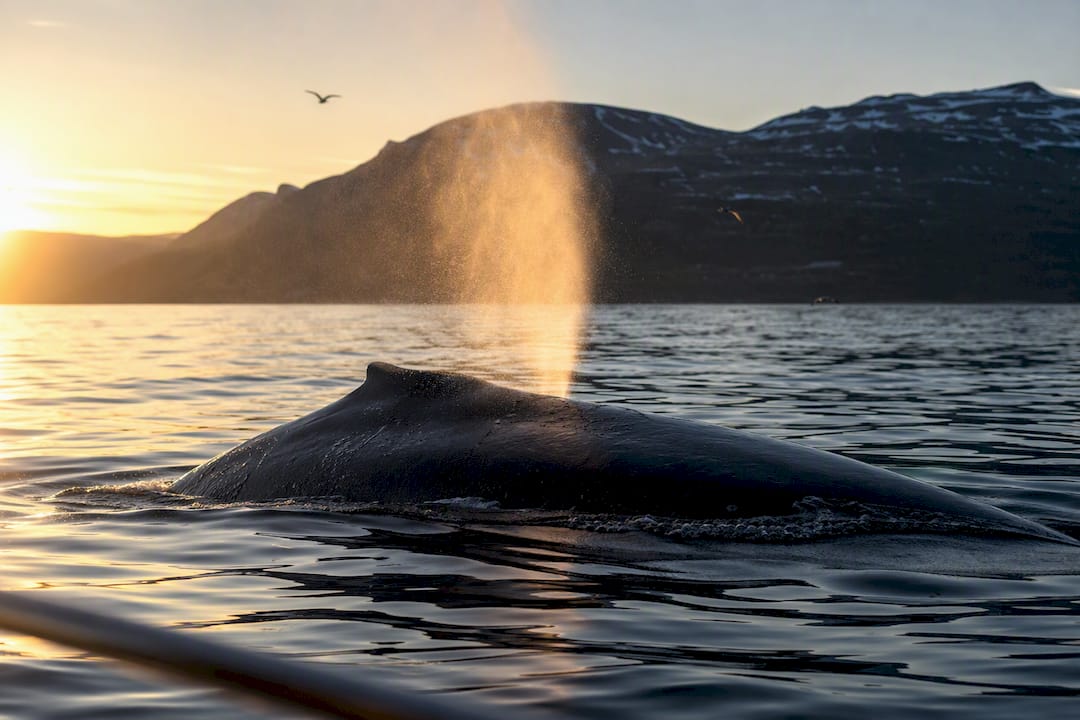
Fjord cruises during this period often double as informal wildlife excursions. Guides watch for orca and humpback whale activity in the channels around Tromsø, and the extended daylight means a boat can linger in a promising area for hours without anyone worrying about getting caught out after dark. Seabird colonies on nearby islands are also active around the clock, giving photographers unusual flexibility to shoot nesting behavior at any hour they choose.
On land, the tundra and mountainsides come alive with wildflowers through June and July, a sharp contrast to the snow-covered terrain most visitors associate with Arctic Norway. Reindeer are commonly seen grazing on hillsides in the region during summer, often close enough for a respectful, quiet photograph from a distance.
What makes this season distinct isn't just what you can see, but when. A guide with strong local knowledge of tide patterns and feeding times can time a fjord cruise to intersect with wildlife activity, something that's far harder to plan around during the short daylight hours of winter.
Health and Safety: Sleep, Sun Exposure, and Adjusting to Constant Daylight
Round-the-clock daylight throws off your body's normal cues for sleep, and most visitors notice it within a day or two of arriving. Melatonin production runs on darkness, so a hotel room with thin curtains and a sky that never dims can leave you wired well past a normal bedtime.
Pack an eye mask and ask your accommodation about blackout curtains before you arrive. Many hotels in Tromsø are used to this request during summer and have you covered, but it's worth confirming rather than assuming.
Sun exposure is the other overlooked factor. Because the sun sits low on the horizon for hours rather than beating down overhead, people often forget sunscreen entirely, assuming weak-looking light can't burn. UV exposure at that latitude in summer is real, and long outdoor photography sessions mean extended, if gentle, exposure. Bring sunglasses too. Staring toward a low horizon for a sunset shot that never actually finishes can strain your eyes more than a normal sunset would.
A private tour with built-in breaks and flexible pacing tends to be easier on your body than a packed group itinerary that pushes straight through the night chasing a schedule.
Why Private, Small-Group Tours Work Better for This Season
Private and small-group formats keep the pace built around the light, not around a fixed departure sheet. That distinction matters more here than almost anywhere else, because midnight sun conditions shift by the hour, and a group tour locked to a schedule can't wait out a passing cloud bank the way a private guide can.
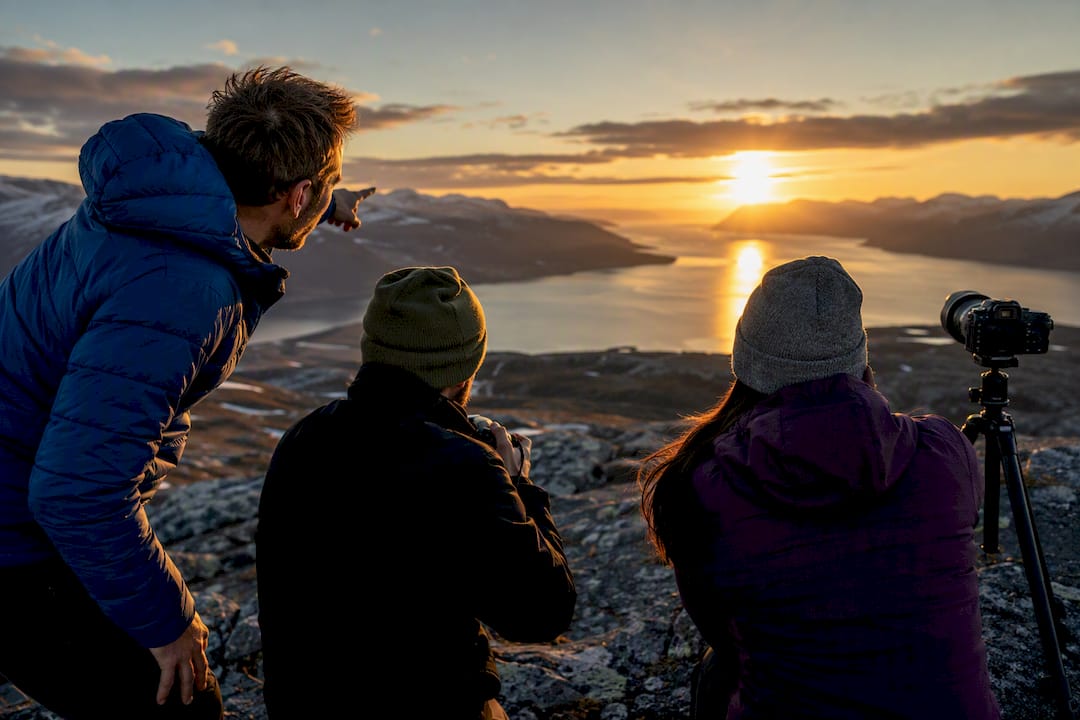
Some operators build their midnight sun experiences around local guides who know which fjord angle will catch reflections at 11:40 p.m. versus 12:30 a.m., and around keeping groups small enough that nobody is rushing a photographer off a tripod position. Sustainability and community involvement are valued aspects. Guides who live in the region tend to have a direct stake in keeping these landscapes intact for future visitors.
— Crystal Sky Venture
Book a Private Midnight Sun Tour With Crystal Sky Venture
Private midnight sun experiences can be built around your schedule, not a bus timetable. If you want reflections and open water, the private Arctic fjord expedition covers calm channels and hidden coastal viewpoints most group tours never reach.
If your priority is dedicated shooting time and route flexibility built around changing light, the bespoke expedition lets you set the pace and stops with a local guide who adjusts in real time. Some trips run as private or small-group outings with local guides, incorporating low-impact practices as part of the tour design. Check current availability and get a custom itinerary through the full tour lineup, or reach out directly to plan a private midnight sun outing around your dates.