
Yes, you can see the aurora during a full moon. The moon changes how faint auroral displays appear against a brighter sky, but it does not touch the solar and geomagnetic activity that actually produces the northern lights. Weak shows (Kp 1 to 2) get washed out fastest. Anything Kp 3 or higher usually punches through just fine.
TL;DR:
- The Kp index is the most reliable indicator, with levels of 3 or higher generally visible even during a full moon, while Kp 1-2 often gets washed out.
- Moon position significantly impacts visibility, especially if the moon is overhead, and checking moonrise and moonset times can reveal hours of dark sky during peak aurora hours.
- Bright moonlight floods the sky with reflected light, reducing dark adaptation and washing out faint auroras, making stronger displays easier to see regardless of moon phase.
- Photographers can use moonlight to illuminate foreground scenery and adjust camera settings, like higher ISO and shorter exposures, to capture auroras in moonlit conditions.
- Guided tours that track moonrise, geomagnetic forecasts, and regional weather optimize chances by repositioning small groups towards the darkest and clearest sky patches, especially during marginal conditions.
Table of Contents
- Why Moonlight Doesn't Change Auroral Physics
- How Aurora Strength and Moon Position Change What You See
- Camera Settings and Composition for a Moonlit Aurora
- Planning Around Moonrise, Forecasts, and Location
- Your Full-Moon Aurora Night Checklist
- How Crystal Sky Venture Handles Full-Moon Nights
- What Actually Matters More Than the Moon Phase
- Book a Guided Aurora Night That Works Around the Moon
- Sources
Why Moonlight Doesn't Change Auroral Physics
Aurora happens because charged particles from the sun slam into Earth's magnetic field and atmosphere, not because of anything happening on the moon. That process runs on solar wind speed and geomagnetic storm strength, and the moon has zero pull on either one. A full moon's only real effect is optical: it floods the sky with reflected sunlight, and that ambient glow works against faint auroral structure the same way a streetlight washes out stars.
Your eyes adapt to darkness over roughly 20 to 30 minutes, and that dark adaptation is precisely what a bright moon interrupts. Once your pupils constrict and your rod cells stay less sensitive, the delicate greens and pale ribbons of a modest aurora blend into the background sky instead of standing out. A strong aurora, with more intense color and sharper edges, doesn't need that contrast advantage nearly as much.
This is why two people can stand under the same full moon on the same night and walk away with opposite stories. One catches a faint Kp 1 glow that barely registers against moonlit clouds and calls the night a bust. The other watches a Kp 4 substorm rip green curtains across the sky and can't stop talking about it. Cloud cover and solar activity remain the real gatekeepers of visibility, and the moon only tips the scale when everything else is already borderline.
How Aurora Strength and Moon Position Change What You See
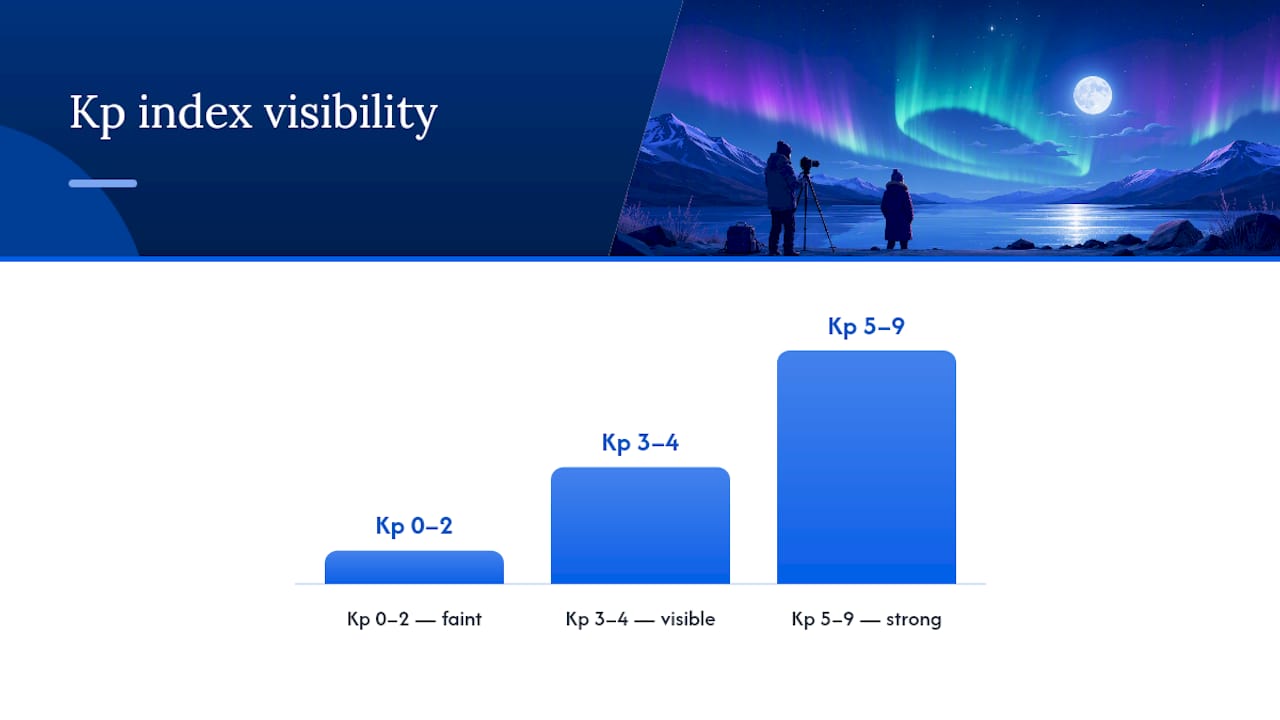
The single most useful number to check before heading out is the Kp index, a 0 to 9 scale that measures geomagnetic disturbance. At Kp 1 or 2, plan on a bright moon erasing most of what you'd otherwise notice. At Kp 3 and above, the display typically has enough intensity to read clearly even with a full moon sitting overhead.
Moon position matters just as much as moon phase. This is the detail most people miss. A "full moon week" doesn't mean the moon is up all night. Moonrise and moonset timing can leave several moon-free hours smack in the middle of prime aurora viewing, typically between 10 PM and 1 AM local time. Check the exact times for your location rather than assuming the whole night is lost.
A few conditions stack against you at once:
- A high, near-overhead moon washes out low-horizon aurora arcs far more than a moon still low near the skyline
- Fresh snow reflects moonlight back into the sky, adding to the ambient brightness problem
- Town light domes plus moonlight plus thin cloud can combine to bury even a moderate display
Pro Tip: If your forecast shows a Kp of 2 with a full moon directly overhead, don't cancel the night. Just shift your expectations toward landscape shots and check back after the moon drops toward the horizon.
Camera Settings and Composition for a Moonlit Aurora
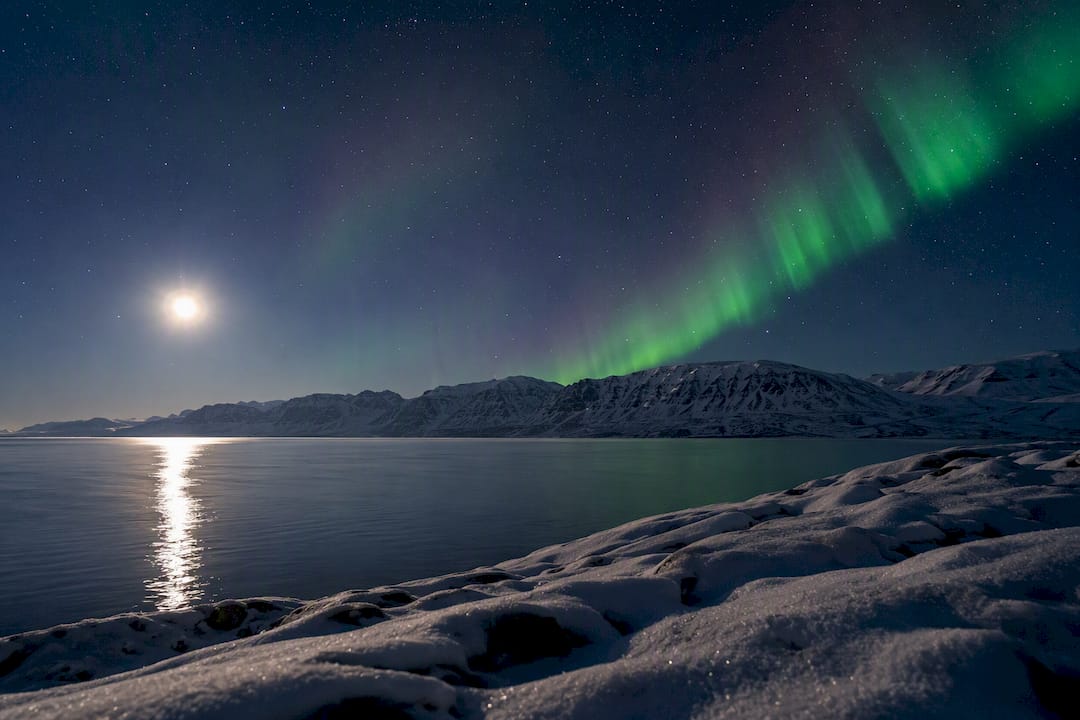
Moonlight is actually a gift for photographers once you know how to use it. It lights up foreground snow, mountains, and fjords that would otherwise sit as black silhouettes, and it lets you shoot at settings that would be impossible on a pitch dark, new moon night.
- Strong aurora with a full moon: Try ISO 800 to 1600, an aperture around f/2.8, and an exposure of 3 to 8 seconds. The moonlight fills in your foreground while the shorter exposure keeps auroral shapes crisp instead of blurring them into a green smear.
- Moderate aurora with a full moon: Push exposure to 8 to 15 seconds at similar ISO and aperture settings, giving the camera more time to gather faint color without overexposing the moonlit snow.
- Faint aurora with a full moon: Lower ISO settings and lengthen exposure times to capture faint displays, keeping in mind that some sky detail may be lost due to increased ambient light.
Shoot in RAW every time, since it gives you room to fix white balance later without wrecking color depth. Set white balance manually rather than trusting auto: shift toward roughly 4800K to match moonlight's daylight-like color temperature, instead of the 4000K that suits a moonless sky. Stopping down slightly and bracketing exposures helps you capture both the bright foreground and the aurora structure in a single sequence, then blend or stitch them later. Watch your framing so the moon itself doesn't drift into frame and blow out as a flare.
Planning Around Moonrise, Forecasts, and Location
Moon position beats moon phase every time you're deciding whether to go out. Look up moonrise and moonset for your exact coordinates rather than relying on a general "full moon this week" headline, since a few hours of moon-free sky during prime viewing time can completely change your night.
Pair that with a live geomagnetic forecast. The SWPC 30-minute aurora forecast updates constantly and gives you the closest thing to a real-time read on activity, and the Geophysical Institute at the University of Alaska Fairbanks offers similar live monitoring if you want a second data point.
Site selection still counts for plenty:
- Pick a spot with an open horizon, since low-lying aurora needs a clear sightline north
- Get away from town light domes, which stack with moonlight to bury weaker color
- Remember fresh snow reflects both moonlight and city glow right back at the sky
Stay flexible. If your first spot looks washed out, moving 20 minutes down the road toward clearer sky or a moon-blocking ridge can save the whole night.
Your Full-Moon Aurora Night Checklist
Run through this before you leave the house, then again once you're on site.
- Before you go: Check moonrise and moonset for your location, pull the current Kp forecast, scan cloud radar, and charge every battery you own since cold drains them fast.
- On site, low Kp and high moon: Shift your priority to landscape and foreground photography using the moonlight, and treat any faint aurora glow as a bonus rather than the main event.
- On site, Kp 3 or higher: Prioritize the aurora itself. Shorten exposures, watch your histogram for blown highlights on snow, and reposition if a ridge or building blocks your northern view.
- Comfort and safety: Dress in real layers, take warm breaks in a vehicle or shelter, and if you're guiding others, build in check-ins so nobody quietly freezes while waiting for a substorm.
How Crystal Sky Venture Handles Full-Moon Nights
Guides who run aurora tours regularly treat moonrise tables the way pilots treat weather reports: checked constantly, trusted completely. Local guides plan around exact moonrise and moonset windows for the fjords and viewpoints near Tromsø, then reposition small groups during the night to chase whichever patch of sky is darkest and clearest at that hour.
Some guests actually request a bright moon on purpose, since it turns a plain snowy landscape into a lit, photogenic foreground for the kind of shot that a pitch dark night can't produce. Crystal Sky Venture builds its private tours around small groups and flexible, bespoke itineraries specifically so a guide can make that judgment call in real time instead of sticking to a fixed script.
What Actually Matters More Than the Moon Phase
Most advice on this topic obsesses over the calendar and treats "full moon" as a warning label. That framing is backwards. The number worth watching is the Kp forecast, not the lunar phase, and the timing detail worth checking is moonrise and moonset, not whether tonight technically counts as full.
The bigger mistake I see people make is canceling plans outright over a full moon forecast, when a Kp 3 night with the moon low on the horizon can outperform a moonless Kp 1 night by a wide margin. Conventional wisdom treats the moon as an obstacle to work around. Field experience suggests treating it as a variable to plan with, since it hands you free foreground light that a dark sky never offers.
Prioritize activity level first, moon position second, and phase dead last. Get that order right and a full moon stops being a reason to stay home.
— Crystal Sky Venture
Book a Guided Aurora Night That Works Around the Moon
Planning a full-moon aurora chase alone means juggling Kp forecasts, moonrise tables, cloud radar, and driving to whichever viewpoint might still be dark enough, all while hoping you picked right. A private tour removes that guesswork: local guides track moonrise timing, live geomagnetic activity, and regional cloud patterns, and reposition small groups mid-night to land in the darkest, clearest patch of sky available.

That local knowledge matters most precisely on nights when conditions are marginal, which is exactly when a full moon puts the most pressure on your viewing spot. Groups stay small, itineraries stay flexible, and guides bring photography support so you're not fumbling with white balance and exposure settings in the cold and dark. If you want that kind of backup on your next trip north, look at the private Northern Lights tour with an Aurora Guarantee and check available dates around your travel window.
Sources
- Aurora: Will a full moon ruin my Northern Lights experience?
- Photographing the northern lights with a full moon
- How the Moon Affects the Northern Lights (and Iceland's darkest nights in 2026-27)